Global trade depends on equipment that often disappears behind booking screens and port schedules. The freight container is not merely a steel box. Its design affects cargo protection, loading speed, transport cost, and delivery reliability.
UNCTAD’s Review of Maritime Transport 2024 confirms that maritime shipping carries over 80% of global merchandise trade by volume. That scale makes container selection a commercial decision, not a minor purchasing detail. Drewry’s Container Census and Leasing Annual Review also shows how container fleets continue evolving across sizes, ownership models, and specialized equipment. Buyers therefore need more than a simple list of standard boxes.
This guide examines ten widely used container types for international buyers. It considers dry containers, high-cube units, refrigerated containers, open-top models, flat racks, tank containers, side-door designs, insulated units, pallet-wide containers, and half-height containers. Each type solves a different physical problem. A reefer may protect fresh produce, while a flat rack may carry machinery with unusual dimensions. Small details matter. Door clearance matters. Internal height matters. Floor strength matters.
Compliance remains essential. Buyers should verify ISO specifications, valid CSC safety plates, inspection records, and suitability for the intended route. A container can look clean and still hide corrosion beneath its floor. That risk is easy to underestimate. The ranking is useful, but it is not universal. Cargo density, climate, handling equipment, port access, and total landed cost can change the best choice. Practical judgment still matters. This is where many purchasing decisions become imperfect, and careful review is necessary.
What Freight Containers Are and How They Are Classified
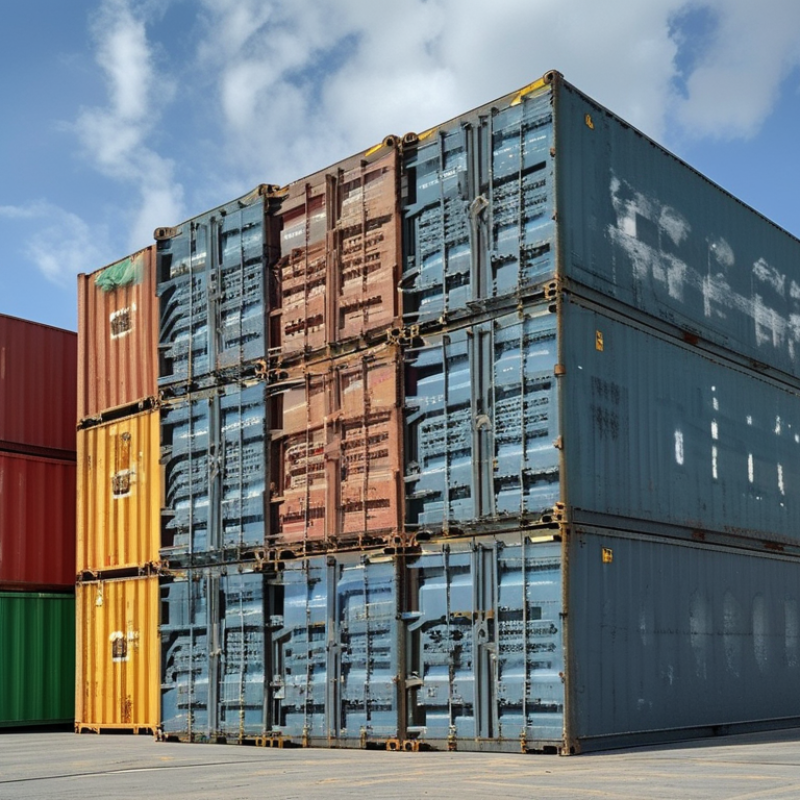
Freight containers are standardized steel units designed for repeated transport by ship, rail, and truck. ISO 668 classifies them by dimensions, structure, and handling requirements. The common 20-foot and 40-foot units are measured in TEU, or twenty-foot equivalent units. UNCTAD’s Review of Maritime Transport 2024 reported that global container ship capacity exceeded 29 million TEU in 2024, showing the scale of this equipment system.
The main types include general-purpose dry containers, high-cube containers, refrigerated containers, insulated containers, ventilated containers, open-top containers, flat racks, platforms, tank containers, and side-opening containers. Dry units suit boxed cargo, while high-cube models provide extra internal height. Reefer containers control temperature, but their machinery needs regular inspection. Open-top units handle tall cargo with removable roof covers. Flat racks and platforms support oversized loads. Tank containers carry regulated liquids under applicable transport rules. Side-opening designs improve access for long or palletized goods. Classification is not only about size. It also considers payload, door layout, floor strength, ventilation, temperature control, and lifting points.
A 40-foot high-cube container may offer useful volume, yet it can exceed local road-height limits. That detail is often missed during purchasing. The Container Owners Association also emphasizes inspection, maintenance, and equipment condition as practical risk controls. A container can meet ISO dimensions and still be unsuitable for a buyer’s cargo. Classification helps narrow the choice, but real loading trials remain valuable. The categories are useful, not perfect.
Representative cargo volume by common ISO freight-container type. Values are typical nominal capacities in cubic metres and may vary by manufacturer, insulation, door configuration, and operating requirements.
General-purpose and high-cube containers maximize dry-cargo volume, while refrigerated, open-top, and tank containers trade some volume for temperature control, top loading, or liquid transport.
Global buyers usually begin with standard dry containers. They suit cartons, pallets, furniture, and packaged machinery. Common lengths are 20 and 40 feet. High-cube containers add about 30 centimeters of internal height, helping with bulky but lightweight cargo. A 40-foot high-cube unit offers roughly 76 cubic meters of volume, depending on its design.
Open-top containers solve a different problem. Their removable roof allows cranes to load stone, timber, or tall equipment from above. Cargo must remain within safe weight and lashing limits. Flat-rack and platform containers handle oversized machinery, while refrigerated, insulated, ventilated, tank, side-door, and swap-body containers serve more specialized logistics needs. These ten types cover most commercial planning discussions, but actual availability can change by port and season.
Drewry’s Container Census 2024 estimated the global container fleet at more than 53 million TEU, showing the scale of equipment choices. UNCTAD’s Review of Maritime Transport 2024 also highlights continuing pressure on capacity, routing, and freight reliability. Buyers should verify ISO 668 dimensions, CSC safety plates, tare weight, floor condition, and door seals before booking. A clean exterior is not enough. I would inspect corner castings and internal odors too. High-cube space can reduce freight cost, yet poor cargo restraint can erase that benefit quickly. Open-top loading also needs a measured lifting plan, not a rough estimate.
Typical specifications for international freight planning. Dimensions and payload limits vary by container design, construction year, and applicable safety regulations.
| Rank | Container Type | Best Suited For | Common Size Options | Typical Internal Dimensions (Length × Width × Height) |
Typical Door or Loading Opening | Typical Internal Volume | Typical Payload Range | Key Characteristics |
|---|---|---|---|---|---|---|---|---|
| 1 | Standard Dry Container | General cargo, cartons, furniture, machinery, packaged goods, and non-temperature-sensitive products. | 20 ft, 40 ft | 20 ft: approximately 5.90 × 2.35 × 2.39 m 40 ft: approximately 12.03 × 2.35 × 2.39 m |
Approximately 2.34 m wide × 2.28 m high | 20 ft: about 33 m³ 40 ft: about 67 m³ |
Approximately 26,000–28,300 kg | The most widely used container type. It has a fully enclosed steel or aluminum body with rear cargo doors. |
| 2 | High-Cube Dry Container | Voluminous or lightweight cargo requiring extra vertical clearance. | 40 ft, 45 ft | 40 ft: approximately 12.03 × 2.35 × 2.69 m 45 ft: approximately 13.56 × 2.35 × 2.69 m |
Approximately 2.34 m wide × 2.58 m high | 40 ft: about 76 m³ 45 ft: about 86 m³ |
Approximately 26,000–28,300 kg | Provides about 30 cm more internal height than a standard dry container and is commonly selected for high-volume cargo. |
| 3 | Open-Top Container | Heavy, oversized, or top-loaded cargo such as stone, scrap metal, timber, and industrial equipment. | 20 ft, 40 ft | 20 ft: approximately 5.89 × 2.35 × 2.35 m 40 ft: approximately 12.03 × 2.35 × 2.35 m |
Removable tarpaulin roof or open top; rear doors usually provide approximately 2.34 m width | 20 ft: about 32 m³ 40 ft: about 65 m³ |
Approximately 26,000–28,000 kg | Cargo can be loaded by crane through the roof. The overall cargo height may be restricted by route and lashing requirements. |
| 4 | Refrigerated Container | Frozen food, fresh produce, pharmaceuticals, chemicals, and other temperature-controlled cargo. | 20 ft, 40 ft High-Cube | 20 ft: approximately 5.44 × 2.29 × 2.26 m 40 ft High-Cube: approximately 11.58 × 2.29 × 2.54 m |
Approximately 2.29 m wide × 2.26–2.54 m high | 20 ft: about 28 m³ 40 ft High-Cube: about 67 m³ |
Approximately 25,000–29,000 kg | Uses an integrated refrigeration unit and requires an external electrical power supply during storage or transport. |
| 5 | Flat-Rack Container | Heavy machinery, vehicles, pipes, construction equipment, and wide or tall project cargo. | 20 ft, 40 ft | 20 ft platform: approximately 5.62 × 2.20 m 40 ft platform: approximately 12.06 × 2.08 m |
Open sides and top; folding or fixed end walls on many models | Not normally rated by enclosed volume | Approximately 21,500–40,000 kg, depending on design | Designed for concentrated or over-width loads. Cargo must be properly secured and may require special transport approval. |
| 6 | Tank Container | Bulk liquids, liquefied gases, powders, food-grade liquids, and regulated chemicals. | 20 ft frame; tank volumes commonly 21,000–26,000 liters | External footprint is approximately 6.06 × 2.44 m; tank dimensions vary by capacity and substance | Top manway and bottom discharge fittings; configuration depends on cargo requirements | Typically 21–26 m³ | Often approximately 20,000–26,000 kg | Must meet applicable tank, pressure, dangerous-goods, food-safety, and inspection requirements for the intended cargo. |
| 7 | Ventilated Container | Coffee, cocoa, potatoes, onions, timber, and other cargo that benefits from controlled natural airflow. | Primarily 20 ft | Approximately 5.90 × 2.35 × 2.39 m | Standard rear doors; passive ventilation openings are integrated into the container walls | About 33 m³ | Approximately 26,000–28,000 kg | Ventilation reduces heat and moisture accumulation but does not provide active temperature control like a refrigerated container. |
| 8 | Insulated Container | Cargo requiring improved thermal stability without continuous mechanical refrigeration. | 20 ft, 40 ft | Approximately 5.80–12.00 × 2.30–2.35 × 2.30–2.65 m, depending on insulation thickness | Typically approximately 2.30–2.34 m wide with insulated rear doors | Approximately 30–75 m³ | Approximately 25,000–28,000 kg | Insulation slows temperature change but does not independently maintain a set temperature. Suitability depends on transit time and ambient conditions. |
| 9 | Side-Door Container | Retail fixtures, pallets, long items, event equipment, and cargo requiring frequent side access. | 20 ft, 40 ft | 20 ft: approximately 5.90 × 2.35 × 2.39 m 40 ft: approximately 12.03 × 2.35 × 2.39 m |
Full-length side opening on one or both sides, plus standard rear doors | 20 ft: about 33 m³ 40 ft: about 67 m³ |
Approximately 26,000–28,000 kg | Improves loading flexibility and access to individual pallets. Side-door designs may have a slightly higher tare weight. |
| 10 | Platform Container | Extremely heavy, wide, long, or irregularly shaped project cargo. | 20 ft, 40 ft | 20 ft platform: approximately 6.06 × 2.44 m 40 ft platform: approximately 12.19 × 2.44 m |
Completely open platform with no side walls or end walls | Not rated by enclosed volume | Approximately 20,000–40,000 kg, depending on the platform type | Allows cargo to overhang the platform within approved limits. It requires detailed weight distribution, lashing, and route planning. |
Top 10 Types of Freight Containers for Global Buyers?
Flat rack, platform, and specialized cargo containers serve loads that standard boxes cannot handle. Flat racks have collapsible end walls and reinforced floors. They suit excavators, steel coils, timber, and oversized machinery. Platform containers remove the end walls entirely. Their open deck supports unusually wide or heavy cargo.
According to UNCTAD’s Review of Maritime Transport 2024, global seaborne trade reached about 12.3 billion tonnes in 2023. This scale makes correct container selection critical. A flat rack may simplify crane handling, but its cargo often needs professional lashing and route clearance. One weak securing point can damage both equipment and schedules. ISO 668 dimensions help buyers compare units, while the CSC Convention supports structural safety inspections.
Specialized options include open-top containers, refrigerated units, tank containers, and ventilated containers. Open-tops handle tall cargo loaded by crane. Refrigerated units protect temperature-sensitive goods, but power interruptions remain a practical risk. Tank containers transport approved liquids under strict technical controls. They are not a universal solution.
The World Bank’s Logistics Performance Index 2023 highlights major differences in tracking, timeliness, and border efficiency across markets. Buyers should therefore check port equipment, inland road limits, payload ratings, inspection records, and cargo dimensions. I have seen buyers focus on purchase price and overlook handling fees. That decision often proves expensive. No container choice is perfect.
Refrigerated Containers Refrigerated containers protect temperature-sensitive cargo during long ocean routes. Buyers should confirm the required temperature range, airflow pattern, and backup power plan. A pre-trip inspection should test the compressor, door seals, sensors, and drainage system. Cargo must stay below the air-return line. Otherwise, cold air may circulate poorly. A simple data logger can reveal temperature changes that the control panel misses. This small device adds useful evidence during delivery checks.
Tank Containers Tank containers suit approved food-grade, chemical, and industrial liquids. The tank needs a suitable pressure rating, interior lining, valve design, and cleaning record. Buyers should request inspection certificates and confirm loading compatibility before shipment. Check every cap and valve. A minor seal problem can create leakage, delays, and expensive cargo loss. Tank capacity also affects handling, because weight distribution changes transport safety and terminal procedures.
Ventilated Containers Ventilated containers allow controlled air exchange for cargo affected by heat or moisture. They can support products such as coffee, cocoa, timber, and selected agricultural goods. However, ventilation does not provide active cooling. Buyers should review vent locations, humidity risks, packaging strength, and the expected route climate. In practice, specifications are sometimes vague. I would question any quotation that says “ventilated” without stating airflow details. No container is perfect for every shipment, and a rushed selection can expose weaknesses only after loading.
Global buyers choose freight containers by cargo needs, route conditions, and handling equipment. A standard dry container suits boxed goods, furniture, and machinery with normal dimensions. A high-cube model adds valuable vertical space for lightweight cargo. This small difference can reduce loading pressure. It can also change transport costs.
Temperature-sensitive products require a refrigerated container with stable cooling performance and reliable power access. Open-top containers help load tall machinery by crane. Flat-rack units support oversized equipment, while platform containers handle exceptionally wide cargo. Tank containers are designed for approved liquid shipments. Insulated containers protect goods from rapid temperature changes. Side-door containers improve access at warehouses. Bulk containers suit certain dry, free-flowing materials.
The best choice starts with accurate cargo measurements, including packaging and lifting points. Measure twice. A few extra centimeters may prevent costly delays. Buyers should check maximum payload, door dimensions, floor strength, ventilation, and compatibility with port equipment. For long routes, inspect corner posts, locking bars, roof condition, and container floors. Salt air and rough handling leave clues.
Experienced purchasing teams also compare availability at origin and return requirements at destination. A specialized container may fit the cargo perfectly but remain difficult to source locally. Quoted freight rates can look attractive until repositioning, storage, or inspection fees appear. No selection method is flawless. Weather, port congestion, and inaccurate packing estimates can still disrupt a careful plan. Reliable suppliers should provide inspection records, clear specifications, and realistic delivery timelines.